Practical, no-fluff articles on exporting from India, finding verified buyers and suppliers, payment terms, documentation, and everything in between — written by the WAY Bharat team.


Starting an export business from India can feel overwhelming — the paperwork, the buyers, the compliance. But every successful exporter started exactly where you are now. Here's the roadmap WAY Bharat uses to help first-time exporters go from "I have a product" to "I have a shipment on the water."
Before you export anything, you need an Import Export Code (IEC) issued by the DGFT (Directorate General of Foreign Trade). This is a one-time registration, valid for life, and mandatory for any cross-border shipment. You'll also need:
Not every product is export-ready on day one. Check:
This is where most first-time exporters struggle. Reliable ways to find genuine buyers include:
Always verify a buyer's credentials before shipping — check their trade history, ask for references, and start with smaller trial orders.
Common international payment methods, from safest to riskiest for the exporter:
For first-time relationships, LC or advance payment is strongly recommended.
A standard export shipment needs:
Work with a freight forwarder or logistics partner who understands your product category — perishables, textiles, and machinery all have very different handling and documentation needs.
Once the shipment leaves port, keep the buyer updated with tracking details and documents. A smooth first shipment is the foundation of a long-term buyer relationship — most repeat business comes from exporters who over-communicate during the first order.
What is the first step to start exporting from India?
Register your business and obtain an Import Export Code (IEC) from the DGFT — it's a one-time, lifetime registration required for any cross-border shipment.
Do I need any certification before exporting a product from India?
It depends on the product and destination market — check its HS code classification and whether the importing country requires certifications like FDA, CE, or organic approval.
We work with first-time and experienced exporters alike — helping you find verified buyers, navigate documentation, and manage quality control before your product ever leaves India. If you're just getting started, this is the exact process our team walks clients through every day.
We Are Yours (WAYBHARAT) is an export consulting and global business support company based in India. We help businesses grow internationally through export guidance, verified buyer search, product sourcing, market intelligence, and food processing solutions.
Professional digital guides designed for exporters, traders, sourcing agents, and entrepreneurs. Learn export documentation, global sourcing, international market strategies, risk management, product selection, buyer communication, and profitable business opportunities through practical, industry-focused e-books with ready-to-edit templates.
Visit ebooks.waybharat.com →We Are Yours (WAYBHARAT)
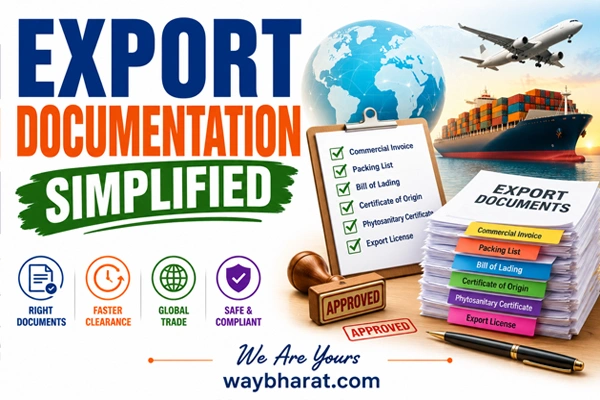
Export documentation trips up more first-time exporters than almost anything else. Missing or incorrect paperwork can delay customs clearance, hold up payment, or get a shipment rejected outright. Here's the complete checklist WAY Bharat uses with every client.
Depending on your product category, buyers or importing-country regulators may require:
The biggest cause of delays isn't missing documents — it's mismatched details across documents. The invoice value, packing list quantities, and bill of lading description all need to tell the exact same story. Before your first shipment, have someone experienced cross-check every document against the others.
What documents are required for exporting from India?
At minimum: a commercial invoice, packing list, bill of lading or airway bill, and certificate of origin, along with a shipping bill filed with Indian customs.
What causes the most export documentation delays?
Mismatched details across documents — such as the invoice, packing list, and bill of lading not agreeing on quantity or value — is the most common cause of customs delays.
WAY Bharat prepares and cross-checks export documentation for clients on every shipment, so nothing gets held up at customs on either end.
We Are Yours (WAYBHARAT) is an export consulting and global business support company based in India. We help businesses grow internationally through export guidance, verified buyer search, product sourcing, market intelligence, and food processing solutions.
Professional digital guides designed for exporters, traders, sourcing agents, and entrepreneurs. Learn export documentation, global sourcing, international market strategies, risk management, product selection, buyer communication, and profitable business opportunities through practical, industry-focused e-books with ready-to-edit templates.
Visit ebooks.waybharat.com →We Are Yours (WAYBHARAT)
"How do I find buyers?" is the question we hear most from first-time exporters. The honest answer: genuine buyers rarely come from cold emails or mass directory listings. Here's where they actually come from.
Platforms built for international trade — sector-specific marketplaces, government trade portals, and industry directories — remain a solid starting point. Treat inbound inquiries with healthy skepticism until verified; volume matters less than quality here.
India has dedicated export promotion councils for almost every product category — spices, textiles, engineering goods, and more. They run buyer-seller meets, maintain vetted buyer databases, and can be a faster route to serious importers than open platforms.
Nothing replaces face-to-face (or video) conversation with a genuinely interested importer. Trade fairs, whether in-person or virtual, let you gauge a buyer's seriousness quickly — their questions about MOQs, lead times, and certifications tell you a lot.
Agencies like WAY Bharat maintain existing relationships with verified overseas buyers actively looking for Indian suppliers. This route skips months of cold outreach, though it's worth understanding the partner's vetting process before relying on it.
Where do exporters find genuine international buyers?
Through B2B trade platforms, sector-specific export promotion councils, trade fairs and buyer-seller meets, and sourcing/facilitation partners with existing verified buyer networks.
How do I verify a buyer before shipping to them?
Check their company registration, trade history, and references, and consider starting with a smaller trial order before committing to a full shipment.
WAY Bharat connects Indian suppliers with pre-verified overseas buyers actively sourcing in their category — no cold outreach required.
We Are Yours (WAYBHARAT) is an export consulting and global business support company based in India. We help businesses grow internationally through export guidance, verified buyer search, product sourcing, market intelligence, and food processing solutions.
Professional digital guides designed for exporters, traders, sourcing agents, and entrepreneurs. Learn export documentation, global sourcing, international market strategies, risk management, product selection, buyer communication, and profitable business opportunities through practical, industry-focused e-books with ready-to-edit templates.
Visit ebooks.waybharat.com →We Are Yours (WAYBHARAT)
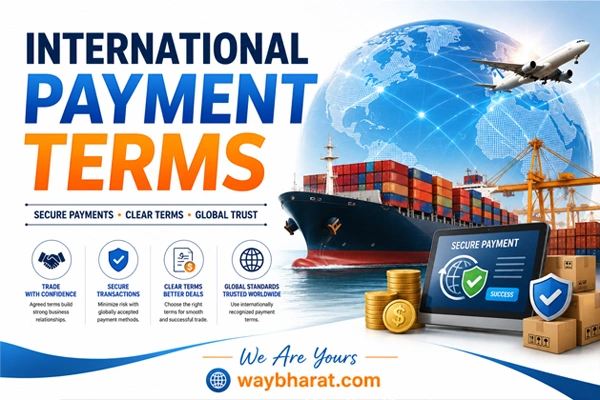
Getting paid is the whole point of exporting, yet payment terms are where many first-time exporters take on the most risk without realizing it. Here's a plain-language breakdown, ranked from safest to riskiest for you as the exporter.
The buyer pays before you ship, in part or in full. Safest for the exporter, but harder to negotiate with a new buyer since it shifts all the risk to them.
A bank-guaranteed payment: the buyer's bank commits to pay once you submit the agreed shipping documents. This is the industry standard for first-time relationships because it protects both sides — you get paid on presenting correct documents, and the buyer is protected because payment only releases against proof of shipment.
Shipping documents are released to the buyer through their bank only once payment is made. Moderate risk — if the buyer refuses to pay, you may need to re-route or sell the goods elsewhere.
Similar to DP, but the buyer receives documents by promising to pay on a future date rather than immediately. This is effectively short-term credit to the buyer — higher risk for the exporter.
Goods and documents go to the buyer first; payment follows later, often 30–90 days after delivery. This is standard between long-established trading partners but carries the highest risk for a new exporter.
For your first few shipments with any new buyer, insist on an LC or advance payment. Once trust is established over several successful orders, you can consider easing toward DP, DA, or eventually open account.
What is the safest payment term for a new exporter?
Advance payment is safest, but a Letter of Credit (LC) is the more commonly workable option since it protects both the exporter and the buyer through a bank guarantee.
What's the difference between Documents against Payment (DP) and Documents against Acceptance (DA)?
DP releases shipping documents to the buyer only once payment is made; DA releases documents against a promise to pay later, which is effectively short-term credit and higher risk for the exporter.
We help first-time exporters structure payment terms that protect their cash flow without scaring off genuine buyers.
We Are Yours (WAYBHARAT) is an export consulting and global business support company based in India. We help businesses grow internationally through export guidance, verified buyer search, product sourcing, market intelligence, and food processing solutions.
Professional digital guides designed for exporters, traders, sourcing agents, and entrepreneurs. Learn export documentation, global sourcing, international market strategies, risk management, product selection, buyer communication, and profitable business opportunities through practical, industry-focused e-books with ready-to-edit templates.
Visit ebooks.waybharat.com →We Are Yours (WAYBHARAT)
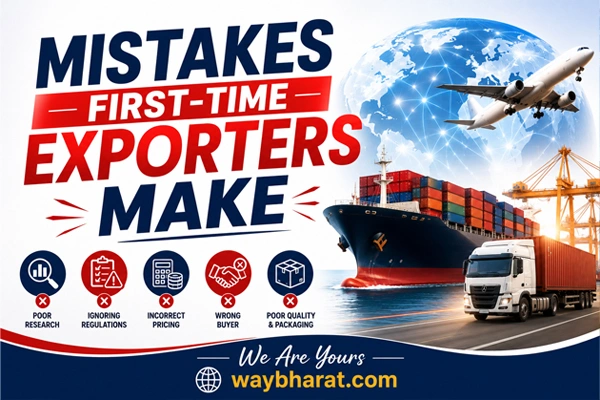
Most export problems aren't caused by bad luck — they're caused by a small set of avoidable mistakes that repeat across almost every first-time exporter we work with. Here are the ones that matter most.
Excitement over a first international order can lead exporters to ship before properly verifying the buyer. Always check trade history and references, and start with a trial order.
Freight, insurance, bank charges, and currency fluctuation all eat into margins if they're not priced in from the start. Build a complete cost sheet before quoting, not after.
Inconsistent details across the invoice, packing list, and bill of lading is one of the most common causes of customs delays on both ends. Cross-check every document before it leaves your hands.
Open account terms with a brand-new buyer sound generous but expose you to non-payment. Reserve easier terms for buyers you've already worked with successfully.
Skipping pre-shipment inspection to save time or cost often costs far more later — in returns, disputes, or a damaged buyer relationship. A small inspection fee is cheap insurance against a rejected container.
Once the goods leave port, staying quiet until the buyer asks for updates erodes trust. Proactively sharing tracking details and documents is what turns a first order into a repeat customer.
What is the most common mistake first-time exporters make?
Skipping buyer verification in the excitement of a first order — always check trade history and references, and start with a trial order.
How can I avoid pricing mistakes when quoting export buyers?
Build a complete cost sheet that includes freight, insurance, bank charges, and currency fluctuation before you quote, not after.
We walk first-time exporters through every one of these steps so the mistakes above don't have to be yours.
We Are Yours (WAYBHARAT) is an export consulting and global business support company based in India. We help businesses grow internationally through export guidance, verified buyer search, product sourcing, market intelligence, and food processing solutions.
Professional digital guides designed for exporters, traders, sourcing agents, and entrepreneurs. Learn export documentation, global sourcing, international market strategies, risk management, product selection, buyer communication, and profitable business opportunities through practical, industry-focused e-books with ready-to-edit templates.
Visit ebooks.waybharat.com →We Are Yours (WAYBHARAT)
The Indian government runs several schemes designed to make Indian exports more competitive globally. Most exporters — especially first-timers — leave money on the table simply because they aren't aware these exist.
Refunds embedded taxes and duties that aren't otherwise rebated, applied as a percentage of the FOB value of exports. It's one of the more broadly applicable schemes and worth checking against your product's HS code.
Allows import of capital goods for pre-production, production, and post-production at reduced or zero customs duty, provided you meet a corresponding export obligation. Useful if you're investing in machinery to scale export production.
Refunds customs duty paid on imported inputs that go into a product you subsequently export — relevant if part of your supply chain relies on imported raw materials or components.
Provides subsidized pre- and post-shipment credit to eligible exporters, easing working capital pressure — particularly valuable for MSMEs financing larger orders.
Supports export promotion activities like trade fairs, market studies, and buyer-seller meets, partially reimbursing costs for eligible exporters exploring new markets.
Scheme eligibility depends on your product's HS classification, export destination, and business structure, and the rules change periodically. It's worth checking current rates with the DGFT or a trade consultant before assuming a scheme applies.
What government schemes support exporters in India?
Key schemes include RoDTEP (tax and duty remission), the EPCG scheme for capital goods import, Duty Drawback on imported inputs, and the Interest Equalisation Scheme for working capital.
How do I know if my product qualifies for RoDTEP?
Eligibility depends on your product's HS code classification — check the current RoDTEP rate schedule against your specific code.
We help exporters identify which schemes actually apply to their product and handle the paperwork to claim them.
We Are Yours (WAYBHARAT) is an export consulting and global business support company based in India. We help businesses grow internationally through export guidance, verified buyer search, product sourcing, market intelligence, and food processing solutions.
Professional digital guides designed for exporters, traders, sourcing agents, and entrepreneurs. Learn export documentation, global sourcing, international market strategies, risk management, product selection, buyer communication, and profitable business opportunities through practical, industry-focused e-books with ready-to-edit templates.
Visit ebooks.waybharat.com →We Are Yours (WAYBHARAT)
For overseas buyers, sourcing from India can feel opaque from the outside — how do you know a supplier is legitimate, that the product matches spec, and that quality holds up at scale? Here's what the process looks like on our end.
Every engagement starts with a detailed brief — product specification, target price range, order volume, packaging requirements, and any certifications you need (organic, FDA, halal, etc.).
We match your requirement against our existing network of manufacturers, checked against production capacity, certifications, export experience, and track record — rather than starting a cold search from scratch.
Shortlisted suppliers provide samples for your review. This is the stage to confirm the product actually matches what you need before any volume commitment is made.
Once a supplier is confirmed, we negotiate pricing, MOQs, lead times, and payment terms on your behalf — leveraging existing relationships to get terms an individual buyer might not access directly.
Pre-shipment inspection checks that the bulk order matches the approved sample — covering quantity, packaging, and quality — before anything leaves the factory.
We coordinate freight booking and prepare full export documentation, so the shipment arrives with everything customs and your own receiving process will need.
What does the product sourcing process from India look like for overseas buyers?
It starts with a detailed requirement brief, moves to supplier shortlisting against a vetted manufacturer network, sample evaluation, pricing negotiation, pre-shipment quality control, and finally logistics and documentation.
How are suppliers verified during sourcing?
Suppliers are matched and checked against production capacity, certifications, export experience, and track record before being shortlisted for a buyer's requirement.
WAY Bharat manages the entire sourcing process end-to-end, so you get a verified product without managing multiple unknown suppliers yourself.
We Are Yours (WAYBHARAT) is an export consulting and global business support company based in India. We help businesses grow internationally through export guidance, verified buyer search, product sourcing, market intelligence, and food processing solutions.
Professional digital guides designed for exporters, traders, sourcing agents, and entrepreneurs. Learn export documentation, global sourcing, international market strategies, risk management, product selection, buyer communication, and profitable business opportunities through practical, industry-focused e-books with ready-to-edit templates.
Visit ebooks.waybharat.com →We Are Yours (WAYBHARAT)
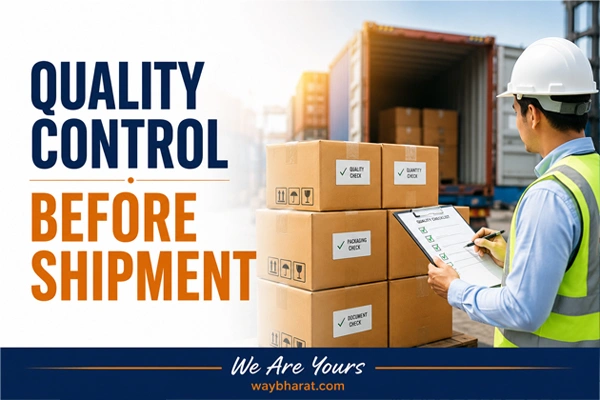
Pre-shipment inspection is the single most effective safeguard against disputes, returns, and damaged buyer relationships — yet it's the step first-time exporters are most tempted to skip to save time or cost.
Inspection typically happens at one of three points:
For the buyer, inspection catches problems before they become expensive returns or rejected shipments. For the exporter, a documented inspection report is protection against unfair disputes later — you have evidence the goods met spec when they left the factory.
An independent inspection service (rather than the supplier self-certifying) gives both sides confidence in the result. For first-time relationships especially, this small cost is worth the protection it provides.
What gets checked during pre-shipment inspection?
Quantity verification, visual and physical checks, functional testing where relevant, packaging inspection, and a sample-to-bulk comparison against the originally approved sample.
When should quality inspection happen?
Most commonly pre-shipment, after production finishes but before goods leave the factory — though inspection can also happen during production or at container loading.
We run pre-shipment inspection on every order we facilitate, with a documented report shared before goods are dispatched.
We Are Yours (WAYBHARAT) is an export consulting and global business support company based in India. We help businesses grow internationally through export guidance, verified buyer search, product sourcing, market intelligence, and food processing solutions.
Professional digital guides designed for exporters, traders, sourcing agents, and entrepreneurs. Learn export documentation, global sourcing, international market strategies, risk management, product selection, buyer communication, and profitable business opportunities through practical, industry-focused e-books with ready-to-edit templates.
Visit ebooks.waybharat.com →We Are Yours (WAYBHARAT)
Logistics is where a well-negotiated export deal can still go wrong if the details aren't handled properly. Here's what first-time exporters need to understand before their first shipment.
A good freight forwarder does more than book cargo space — they advise on the right container type, handle customs clearance, and flag documentation issues before they become delays. Choose one with experience in your specific product category; perishables, textiles, and machinery all have different handling needs.
Incoterms define who's responsible for costs and risk at each stage of shipment. The most common for new exporters:
Share tracking information and shipping documents with the buyer proactively. Buyers who are kept informed during transit are far more likely to place a second order.
What Incoterms should a new exporter understand first?
FOB (exporter's responsibility ends once goods are loaded onto the vessel), CIF (exporter also arranges and pays freight and insurance to destination), and EXW (buyer takes responsibility from the factory gate).
What container type should I use for a food export shipment?
Perishable and temperature-sensitive food products typically require reefer (temperature-controlled) containers, while shelf-stable dry goods can use standard dry containers.
We coordinate freight, documentation, and tracking for every shipment we facilitate, so nothing falls through the cracks at the port.
We Are Yours (WAYBHARAT) is an export consulting and global business support company based in India. We help businesses grow internationally through export guidance, verified buyer search, product sourcing, market intelligence, and food processing solutions.
Professional digital guides designed for exporters, traders, sourcing agents, and entrepreneurs. Learn export documentation, global sourcing, international market strategies, risk management, product selection, buyer communication, and profitable business opportunities through practical, industry-focused e-books with ready-to-edit templates.
Visit ebooks.waybharat.com →We Are Yours (WAYBHARAT)
Even with careful quality control, disputes happen — a shipment arrives damaged, a quantity is short, or a buyer feels the product doesn't match the sample. How you handle the first dispute often determines whether the relationship survives.
Silence or a defensive first response damages trust faster than the original problem. Acknowledge the complaint within 24 hours, even if you don't have a resolution yet.
Request photos, videos, and documentation of the issue. Compare against your own inspection records and shipping documents. Most disputes resolve faster once both sides are looking at the same evidence.
Options include a partial refund, replacement of the affected quantity, or a discount on the next order. The right choice depends on the size of the issue and the value of the relationship — for a buyer you want to keep, err on the side of generosity for a first dispute.
Document what went wrong and adjust your process — tighter inspection, better packaging, clearer specifications — so the same issue doesn't recur with your next buyer.
How should an exporter respond to a buyer complaint?
Acknowledge the complaint within 24 hours even without an immediate resolution, then request photos, videos, and documentation to compare against your own inspection records before assigning blame.
Who is responsible for transit damage to an export shipment?
Transit damage usually falls under insurance — help the buyer file a claim rather than absorbing the cost directly where insurance coverage applies.
When issues come up, we help exporters and buyers work through them fairly — protecting the relationship, not just the transaction.
We Are Yours (WAYBHARAT) is an export consulting and global business support company based in India. We help businesses grow internationally through export guidance, verified buyer search, product sourcing, market intelligence, and food processing solutions.
Professional digital guides designed for exporters, traders, sourcing agents, and entrepreneurs. Learn export documentation, global sourcing, international market strategies, risk management, product selection, buyer communication, and profitable business opportunities through practical, industry-focused e-books with ready-to-edit templates.
Visit ebooks.waybharat.com →We Are Yours (WAYBHARAT)
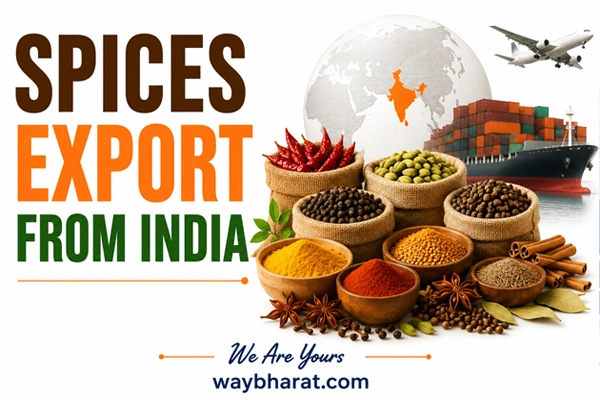
India is one of the world's largest spice producers and exporters, but breaking into the category requires understanding buyer expectations around grading, certification, and packaging that differ from other food exports.
Buyers typically evaluate spices against parameters like moisture content, volatile oil content (for items like pepper and cardamom), extraneous matter, and microbial load. Grading standards vary by product — pepper grades differ from turmeric grades — so check the specific standard your buyer expects.
Moisture control is critical — spices are highly sensitive to humidity, which affects both quality and shelf life. Common export packaging includes multi-layer laminated bags, vacuum packing for ground spices, and food-grade drums or cartons for bulk shipments. Buyers in different markets often have specific labeling requirements (allergen info, country of origin, batch codes) that need to be confirmed before packaging is finalized.
What certifications are needed to export spices from India?
FSSAI registration is mandatory for food exports generally, Spices Board India registration is required specifically for spice exporters, and organic or ISO/HACCP certification is increasingly requested by EU and US buyers.
Why does packaging matter so much for spice exports?
Spices are highly sensitive to moisture, which affects both quality and shelf life — export shipments commonly use multi-layer laminated bags, vacuum packing, or food-grade drums to control humidity.
We connect buyers with verified spice suppliers and handle certification, quality testing, and export documentation end-to-end.
We Are Yours (WAYBHARAT) is an export consulting and global business support company based in India. We help businesses grow internationally through export guidance, verified buyer search, product sourcing, market intelligence, and food processing solutions.
Professional digital guides designed for exporters, traders, sourcing agents, and entrepreneurs. Learn export documentation, global sourcing, international market strategies, risk management, product selection, buyer communication, and profitable business opportunities through practical, industry-focused e-books with ready-to-edit templates.
Visit ebooks.waybharat.com →We Are Yours (WAYBHARAT)
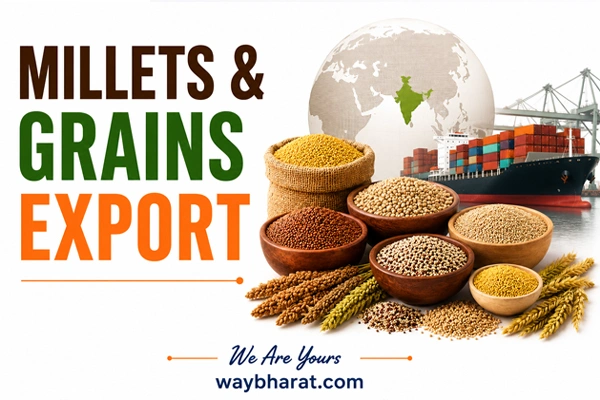
Millets and traditional grains have moved from a niche health-food category to a mainstream demand item internationally, driven by growing interest in gluten-free, high-fiber, and traditional diets. For Indian exporters, this is one of the fastest-growing product segments — but buyers expect the same discipline around quality, consistency, and documentation as any other food export.
Buyers typically assess moisture content, foreign matter, broken grain percentage, and pest/insect infestation levels. Consistency across batches matters more in this category than almost any other — buyers building a repeat supply chain want assurance that this month's shipment matches last month's in taste, cook time, and appearance.
Millets are naturally shelf-stable when properly dried and stored, but packaging still affects buyer confidence. Common formats include moisture-barrier pouches for retail-ready packs, and food-grade woven or laminated bags for bulk shipments. Labeling requirements — nutritional panels, allergen declarations, batch and harvest information — vary by destination market and should always be confirmed with the buyer before finalizing packaging design.
The certification, licensing, and country-specific import requirements for millets and grains vary quite a bit depending on the destination market and product form — this is exactly the kind of detail we walk buyers and exporters through individually rather than generalizing here.
What do buyers check first when sourcing millets from India?
Moisture content, foreign matter, broken grain percentage, and pest/infestation levels, along with consistency across batches for repeat supply.
Is millet export supply available year-round?
It depends on the specific grain and growing region — this is one of the first questions international buyers typically ask before committing to a supply agreement.
We connect buyers with verified millet and grain suppliers and handle quality checks, certification guidance, and export documentation end-to-end.
Beyond sourcing a single product, we help entrepreneurs and existing businesses set up a full export operation — market selection, buyer outreach, licensing guidance, pricing, logistics, and documentation — tailored to your product and budget. If you're planning to start or scale an export business, talk to us and we'll map out the full setup with you.
We Are Yours (WAYBHARAT) is an export consulting and global business support company based in India. We help businesses grow internationally through export guidance, verified buyer search, product sourcing, market intelligence, and food processing solutions.
Professional digital guides designed for exporters, traders, sourcing agents, and entrepreneurs. Learn export documentation, global sourcing, international market strategies, risk management, product selection, buyer communication, and profitable business opportunities through practical, industry-focused e-books with ready-to-edit templates.
Visit ebooks.waybharat.com →We Are Yours (WAYBHARAT)
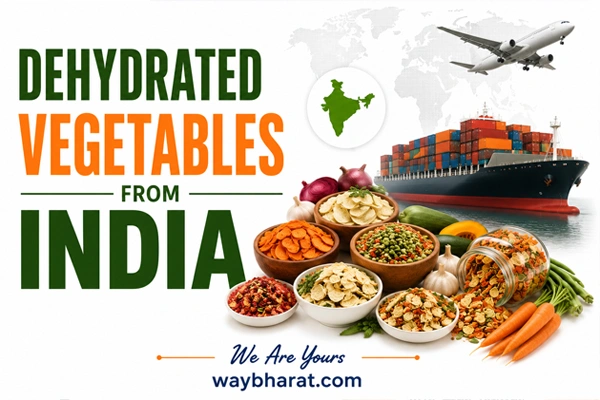
India has emerged as one of the world's leading suppliers of dehydrated vegetables, backed by a strong agricultural base, abundant raw materials, advanced food processing capabilities, and competitive production costs. As food manufacturers increasingly look for ingredients with a longer shelf life, consistent quality, and year-round availability, dehydrated vegetables have become an essential part of the global food industry.
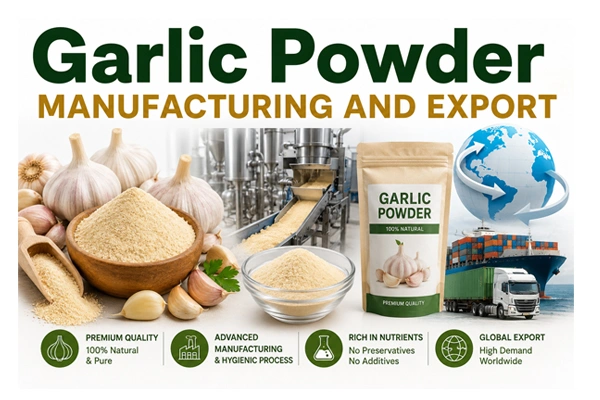
From onion flakes and garlic powder to beetroot powder and mixed vegetable flakes, Indian manufacturers export a wide range of dehydrated products to food processors, supermarkets, restaurant chains, and private-label brands worldwide.
Dehydrated vegetables are fresh vegetables processed to remove most of their moisture through controlled drying methods such as hot air drying, tray drying, belt drying, or freeze drying. Reducing moisture content slows the growth of bacteria, mould, and yeast, keeping the product safe and stable for extended periods — typically 12 to 24 months under proper storage, compared to just a few days for fresh produce — while retaining much of the natural flavour, aroma, colour, and nutritional value.
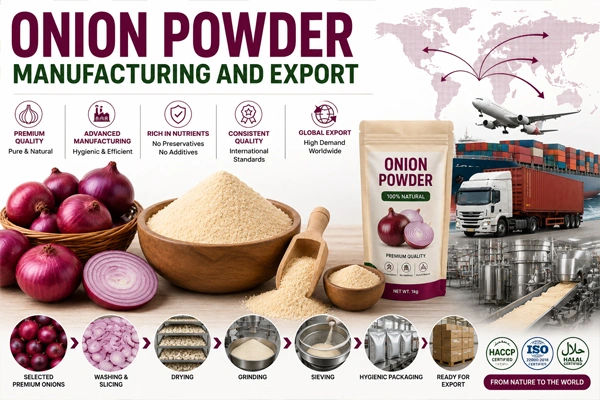
Onion products — flakes, granules, powder, minced and chopped onion — are used across soups, sauces, snack seasonings, ready meals, and spice blends. Garlic products — flakes, granules, powder, and minced garlic — see similar demand from food processors and instant food companies. Other high-demand exports include tomato powder and flakes, beetroot powder, carrot powder, spinach powder, ginger powder, moringa leaf powder, green chilli flakes, cabbage flakes, potato flakes, and customized mixed vegetable blends for industrial food manufacturing.
India combines cost-competitive manufacturing with consistent quality — modern dehydration technology preserves natural taste, aroma, texture, and colour — and a reliable year-round supply thanks to diverse cultivation across the country. Manufacturers can also customize flakes, granules, powders, cube sizes, moisture levels, and packaging to buyer specification.
Indian dehydrated vegetables reach more than 100 countries, with the largest importing markets including the United States, Canada, the United Kingdom, Germany, France, Italy, the Netherlands, Spain, the UAE, Saudi Arabia, Qatar, Oman, Kuwait, Singapore, Malaysia, Australia, New Zealand, Japan, and South Korea.
Major buyers span Ready-to-Eat and Ready-to-Cook food manufacturers, instant noodle makers, soup and sauce producers, snack food companies, spice blenders, frozen food manufacturers, bakery and confectionery brands, meat processors, restaurant chains, hotel and catering suppliers, airline catering services, and private-label food brands.
Export documentation and licensing requirements — IEC, GST, FSSAI, APEDA registration, and destination-specific certificates — vary by product and market, and are best worked through case by case with an export partner rather than generalized here.
The global market for dehydrated vegetables continues to expand as manufacturers seek ingredients that are convenient, cost-effective, and suitable for long-term storage. For exporters and food entrepreneurs, this sector offers strong opportunities to create high-value products, reduce agricultural waste, and build long-term partnerships with international buyers.
What are the most exported dehydrated vegetable products from India?
Dehydrated onion products (flakes, granules, powder) and garlic products lead exports, alongside tomato powder, beetroot powder, carrot powder, and mixed vegetable flakes.
How long do dehydrated vegetables typically last?
Properly processed and packaged dehydrated vegetables typically remain stable for 12 to 24 months, compared to just a few days for fresh produce.
We connect buyers with verified dehydrated vegetable manufacturers and handle quality checks, certification guidance, and export documentation end-to-end.
We Are Yours (WAYBHARAT) is an export consulting and global business support company based in India. We help businesses grow internationally through export guidance, verified buyer search, product sourcing, market intelligence, and food processing solutions.
Professional digital guides designed for exporters, traders, sourcing agents, and entrepreneurs. Learn export documentation, global sourcing, international market strategies, risk management, product selection, buyer communication, and profitable business opportunities through practical, industry-focused e-books with ready-to-edit templates.
Visit ebooks.waybharat.com →We Are Yours (WAYBHARAT)
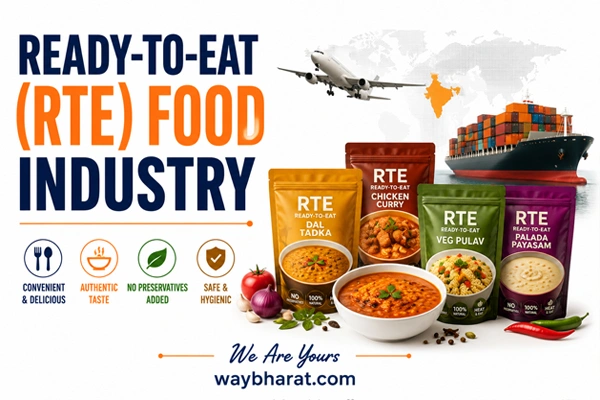
The Ready-to-Eat (RTE) food industry has become one of the fastest-growing sectors in the global food and beverage market. As lifestyles get busier and demand rises for convenient, nutritious, high-quality meals, RTE products have evolved from a niche category into a multi-billion-dollar global industry — creating opportunities for manufacturers, exporters, private-label producers, and entrepreneurs worldwide.
India, with its rich culinary heritage, abundant agricultural resources, and competitive manufacturing capabilities, is emerging as a preferred global supplier of RTE products — from traditional curries and biryanis to millet-based meals and ethnic cuisines — serving markets across North America, Europe, the Middle East, Asia-Pacific, and Africa.
RTE foods are fully cooked, processed, and packaged products that can be consumed immediately or with minimal heating. Modern RTE manufacturing uses retort sterilization, aseptic packaging, freezing, vacuum packaging, and modified atmosphere packaging (MAP) to preserve quality over a long shelf life — an increasingly essential convenience as urbanization and busy schedules reshape everyday eating habits.
Emerging markets across Asia-Pacific, the Middle East, Africa, and Latin America are growing especially fast, while mature markets — the US, Canada, UK, Germany, France, Australia, Japan, and South Korea — continue offering strong import opportunities.
Ready-to-eat meals, canned foods, instant foods, frozen ready meals, retort pouch products, and ethnic foods each serve different consumer occasions and retail formats.
Buyers range from supermarkets, hypermarkets, food importers, and wholesale distributors to ethnic food stores, restaurant and hotel chains, airline caterers, cruise lines, defence and government procurement agencies, institutional buyers, online grocery platforms, and private-label retail brands.
Retort pouches, cans, glass jars, vacuum packs, frozen packs, plastic trays, microwaveable containers, stand-up pouches, cup packaging, and MAP formats each play a role in maintaining quality, extending shelf life, and improving consumer convenience during export.
Plant-based ready meals, high-protein foods, vegan and organic products, gluten-free and millet-based meals, clean-label formulations, preservative-free and functional foods, and sustainable packaging are all shaping where new opportunity is emerging.
Private label and contract manufacturing, OEM production, white label exports, government and defence food supply, disaster relief food kits, HORECA supply, online retail brands, and international distributor partnerships all offer ways to diversify revenue beyond a single market.
Food safety compliance, shelf-life management, cold chain logistics, international regulations, product registration, packaging and labeling compliance, rising freight costs, import duties, and currency fluctuations are the main hurdles — successful exporters invest early in quality systems, regulatory compliance, and efficient supply chains to manage them.
Indian manufacturers are well positioned to benefit from this growth by pairing traditional recipes with modern food processing technology. By focusing on premium quality, international certifications, innovative packaging, strong distributor partnerships, and export marketing, Indian exporters can capture a growing share of the expanding RTE market.
What certifications do RTE food exporters from India need?
Common requirements include an FSSAI license, IEC, HACCP, ISO 22000, BRCGS, GMP, and depending on the market, Halal, Kosher, or US FDA registration.
What packaging formats are used for RTE food exports?
Retort pouches, cans, glass jars, vacuum packs, frozen packs, and modified atmosphere packaging (MAP) are the most common formats for maintaining quality during export.
We help manufacturers plan RTE product development, packaging, certifications, and buyer connections for international markets.
We Are Yours (WAYBHARAT) is an export consulting and global business support company based in India. We help businesses grow internationally through export guidance, verified buyer search, product sourcing, market intelligence, and food processing solutions.
Professional digital guides designed for exporters, traders, sourcing agents, and entrepreneurs. Learn export documentation, global sourcing, international market strategies, risk management, product selection, buyer communication, and profitable business opportunities through practical, industry-focused e-books with ready-to-edit templates.
Visit ebooks.waybharat.com →We Are Yours (WAYBHARAT)
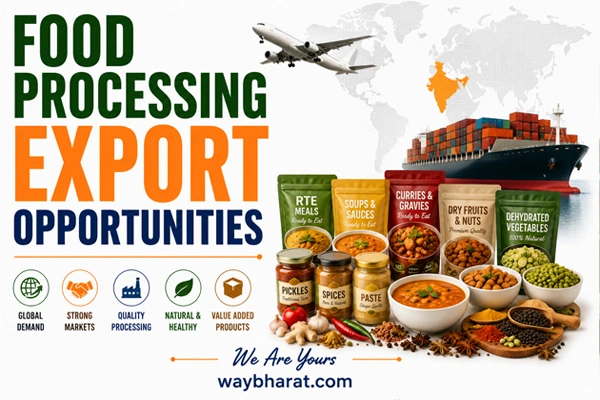
The global food processing industry is undergoing a remarkable transformation as consumers increasingly demand healthy, convenient, long shelf-life, and value-added food products. Changing lifestyles, urbanization, rising disposable incomes, and growing nutrition awareness have significantly increased demand for processed food ingredients across international markets — and India, with abundant agricultural resources, competitive manufacturing costs, and modern processing technology, is well placed to become a leading exporter of value-added food products.
Exporting processed food products offers significantly greater value than exporting raw agricultural commodities. Converting fresh produce into powders, flakes, granules, seasonings, extracts, or dehydrated products improves product value, reduces wastage, extends shelf life, and opens access to premium international markets.
Vegetable powders — beetroot, garlic, red and white onion, tomato, carrot, spinach, and pumpkin powder — are widely used in soups, sauces, instant foods, beverages, bakery products, seasonings, baby foods, and health supplements.
Herbal and superfood powders — moringa, curry leaf, neem, aloe vera, wheatgrass, ashwagandha, tulsi, and spirulina powder — serve the nutraceutical, dietary supplement, functional beverage, and herbal formulation markets.
Spice powders — India's strength as the "Land of Spices" shows in ginger, turmeric, chilli, coriander, cumin, black pepper, cardamom, and cinnamon powder, used extensively by food manufacturers, restaurants, seasoning companies, and retail brands.
Dehydrated vegetable products and spice blends and seasonings — curry powder, garam masala, biryani masala, BBQ and peri-peri seasoning, pizza and noodle seasoning — round out a category well suited to private-label manufacturing.
Government support programs — the Ministry of Food Processing Industries (MoFPI), APEDA, MSME development schemes, and export promotion councils — further encourage investment, modernization, and export competitiveness in this space.
Food processing companies, instant and RTE/RTC manufacturers, snack makers, spice blenders, sauce and seasoning producers, frozen food companies, health supplement and pharmaceutical manufacturers, cosmetic and personal care brands, and even pet food manufacturers all draw on this category — spreading demand across a wide base.
Value-added products — vegetable powders, dehydrated vegetables, herbal powders, spice blends, and functional food ingredients — are set for sustained growth. Instead of exporting raw vegetables alone, entrepreneurs who invest in modern processing technology, quality standards, global certifications, and export marketing can build lasting positions as trusted international suppliers.
Why is food processing more profitable than exporting raw produce?
Converting fresh produce into powders, flakes, granules, seasonings, or extracts improves product value, reduces wastage, extends shelf life, and opens access to premium international markets.
What government support exists for Indian food processors?
Programs from the Ministry of Food Processing Industries (MoFPI), APEDA, MSME development schemes, and export promotion councils support investment, modernization, and export competitiveness.
We help manufacturers identify the right value-added product line, sourcing partners, and certification path for international buyers.
We Are Yours (WAYBHARAT) is an export consulting and global business support company based in India. We help businesses grow internationally through export guidance, verified buyer search, product sourcing, market intelligence, and food processing solutions.
Professional digital guides designed for exporters, traders, sourcing agents, and entrepreneurs. Learn export documentation, global sourcing, international market strategies, risk management, product selection, buyer communication, and profitable business opportunities through practical, industry-focused e-books with ready-to-edit templates.
Visit ebooks.waybharat.com →We Are Yours (WAYBHARAT)
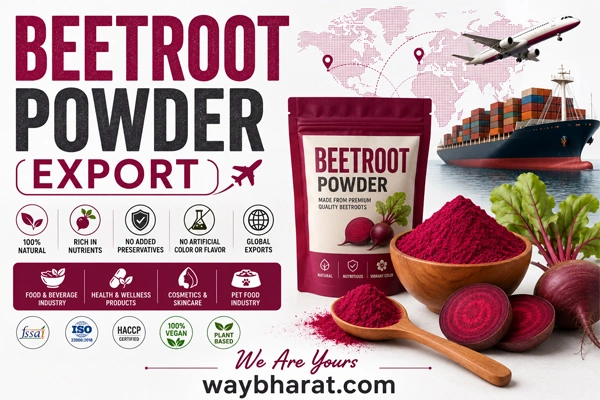
India is rapidly emerging as a leading supplier of beetroot powder to international markets. With rising global demand for natural food ingredients, clean-label products, plant-based nutrition, and natural colorants, beetroot powder has become a high-value export product for food processors and ingredient manufacturers — rich in natural nitrates, antioxidants, dietary fibre, vitamins, and minerals, and used across food, beverage, nutraceutical, pharmaceutical, and cosmetic industries.
Beetroot powder is produced by washing, slicing, dehydrating, and finely grinding fresh beetroot while preserving its natural nutrients, vibrant red colour, and earthy flavour. Depending on buyer requirements, manufacturers can supply fine, spray-dried, organic, freeze-dried, or custom mesh-size powder.
Beetroot powder appears across the food industry (soups, sauces, instant foods, pasta, noodles, bakery products, biscuits, cakes, snacks, breakfast cereals, baby food, ice cream, dairy), the beverage industry (health drinks, smoothies, juice mixes, functional and sports drinks), nutraceuticals (dietary supplements, protein powders, wellness and detox products), pharmaceuticals (herbal formulations, natural health products), and cosmetics (face packs, herbal skin and hair care).
High-quality agricultural raw material, competitive manufacturing costs, year-round production, modern dehydration technology, custom processing options, and reliable export infrastructure make India a strong sourcing choice — with the ability to customize moisture level, particle size, colour value, and packaging to spec.
Food manufacturers, beverage companies, nutraceutical and pharmaceutical manufacturers, bakery and spice companies, health supplement brands, cosmetic manufacturers, private-label companies, food ingredient importers, and online retail brands.
As consumers keep shifting toward natural, nutritious, plant-based products and away from synthetic food colours, demand for beetroot powder is expected to grow steadily. Indian manufacturers who focus on premium quality, international certifications, and innovative packaging are well placed to benefit.
What is beetroot powder used for?
It's used as a natural colorant and functional ingredient in soups, sauces, bakery products, beverages, dietary supplements, and cosmetics.
Why is demand for beetroot powder increasing?
Rising demand for natural food colors over artificial additives, growing plant-based and clean-label trends, and expansion of the nutraceutical and functional beverage markets are driving growth.
We connect food, beverage, and supplement brands with verified beetroot powder manufacturers, handling quality checks and export documentation end-to-end.
We Are Yours (WAYBHARAT) is an export consulting and global business support company based in India. We help businesses grow internationally through export guidance, verified buyer search, product sourcing, market intelligence, and food processing solutions.
Professional digital guides designed for exporters, traders, sourcing agents, and entrepreneurs. Learn export documentation, global sourcing, international market strategies, risk management, product selection, buyer communication, and profitable business opportunities through practical, industry-focused e-books with ready-to-edit templates.
Visit ebooks.waybharat.com →We Are Yours (WAYBHARAT)
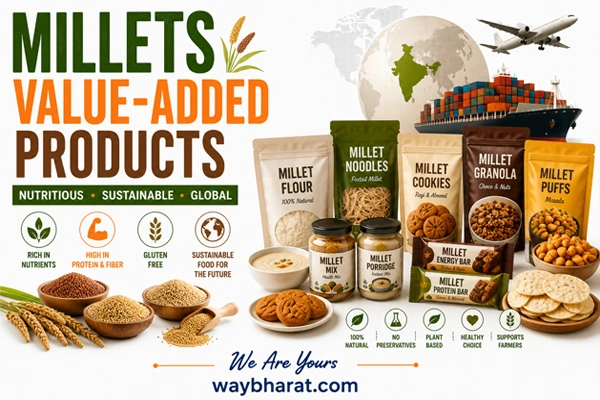
Millets have evolved from traditional grains into one of the fastest-growing categories in the global health food industry. As consumers increasingly seek gluten-free, high-fibre, plant-based, and nutrient-rich foods, millets have gained recognition worldwide as a "super grain." India — the world's largest producer of millets — has an opportunity to move beyond exporting raw grain by manufacturing value-added millet products: ready-to-cook foods, ready-to-eat snacks, breakfast cereals, bakery ingredients, and functional ingredients that increase profitability and open stronger export opportunities across the USA, Europe, the Middle East, Australia, Japan, and Southeast Asia.
Millets are naturally gluten-free, rich in dietary fibre, high in protein, low glycemic index, rich in iron and calcium, and an excellent source of antioxidants — plant-based, sustainable, and suited to diabetic-friendly and weight-management diets. India cultivates a wide variety, including finger millet (ragi), pearl millet (bajra), sorghum (jowar), foxtail, little, kodo, barnyard, proso, and browntop millet.
Rather than exporting raw grain, businesses can manufacture:
Health food companies, food manufacturers, breakfast cereal and bakery makers, snack manufacturers, nutraceutical and baby food companies, hotels and restaurants, airlines and institutional caterers, organic food retailers, supermarkets, private-label brands, online grocery platforms, and food ingredient importers.
Growing awareness of healthy eating, gluten-free diets, sustainable agriculture, and functional nutrition is expected to drive significant global demand over the next decade, as consumers move beyond traditional grains into millet-based breakfast cereals, snacks, bakery products, and ready-to-cook meals. Businesses that focus on quality, product innovation, attractive packaging, and international certifications are best placed to capture this growth.
What value-added millet products have the strongest export demand?
Millet flour, ready-to-cook mixes (idli, dosa, khichdi), ready-to-eat snacks like cookies and energy bars, and functional foods such as millet protein powder are all in high demand.
Who buys value-added millet products internationally?
Health food companies, breakfast cereal and bakery manufacturers, snack producers, organic food retailers, and private-label brands are the main buyers.
We help manufacturers move from raw millet supply to branded, export-ready value-added products, with sourcing, packaging, and buyer connections handled end-to-end.
We Are Yours (WAYBHARAT) is an export consulting and global business support company based in India. We help businesses grow internationally through export guidance, verified buyer search, product sourcing, market intelligence, and food processing solutions.
Professional digital guides designed for exporters, traders, sourcing agents, and entrepreneurs. Learn export documentation, global sourcing, international market strategies, risk management, product selection, buyer communication, and profitable business opportunities through practical, industry-focused e-books with ready-to-edit templates.
Visit ebooks.waybharat.com →We Are Yours (WAYBHARAT)
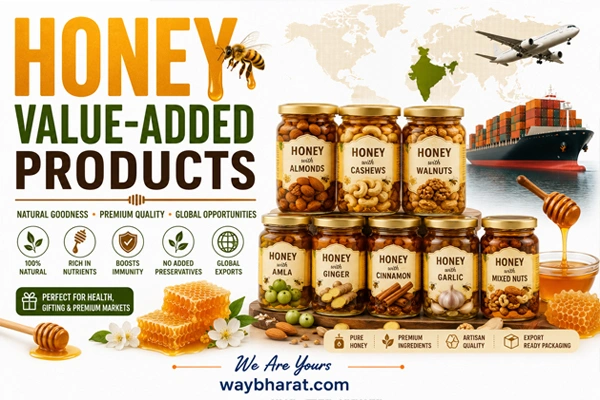
Honey is no longer viewed as just a natural sweetener. It has become one of the fastest-growing ingredients in the health food, nutraceutical, cosmetic, pharmaceutical, and functional food industries, as consumers actively seek natural, chemical-free, and immunity-boosting products. India is one of the world's leading honey-producing countries, offering diverse floral varieties, competitive pricing, and growing processing capability — and rather than exporting raw honey alone, manufacturers can significantly increase profitability by developing value-added honey products for domestic and international markets.
Consumers increasingly choose honey-based products for being natural, free from artificial additives, rich in antioxidants, and a source of vitamins and minerals — popular in functional foods, wellness products, clean-label formulations, and traditional or herbal remedies. This has encouraged food manufacturers to replace refined sugar with natural honey across many product lines.
Processing honey into finished products brings higher profit margins, premium export pricing, a stronger brand identity, a wider product portfolio, better market positioning, long-term customer relationships, private-label manufacturing opportunities, increased retail presence, and year-round sales — rather than selling honey as an undifferentiated commodity.
The global honey industry is expected to keep growing as consumers prefer natural sweeteners, immunity-boosting products, functional foods, and clean-label ingredients — with rising demand not just for raw honey but for flavoured honey, honey powders, nutraceutical products, healthy snacks, beverages, and personal care items. For Indian entrepreneurs, the opportunity lies in innovation and value addition: developing unique honey-based products, investing in attractive packaging, and maintaining international quality standards.
What honey-based products have strong export demand?
Flavoured honey, honey spreads, honey powder, honey-based health products (with turmeric, ginger, or ashwagandha), honey snacks, honey beverages, and cosmetic products all show strong demand.
Why should honey exporters focus on value addition instead of raw honey?
Processed honey products command higher profit margins, premium export pricing, and stronger brand positioning than selling raw honey as a commodity.
We help entrepreneurs and manufacturers develop honey-based products, source processing equipment, and connect with international buyers.
We Are Yours (WAYBHARAT) is an export consulting and global business support company based in India. We help businesses grow internationally through export guidance, verified buyer search, product sourcing, market intelligence, and food processing solutions.
Professional digital guides designed for exporters, traders, sourcing agents, and entrepreneurs. Learn export documentation, global sourcing, international market strategies, risk management, product selection, buyer communication, and profitable business opportunities through practical, industry-focused e-books with ready-to-edit templates.
Visit ebooks.waybharat.com →We Are Yours (WAYBHARAT)
International trade creates global opportunities — but it also attracts fraudsters. Fake buyers, fraudulent suppliers, fake shipping companies, counterfeit financial institutions, and dishonest intermediaries cause millions of dollars in losses every year. Whether you're dealing with a buyer, supplier, sourcing agent, business consultant, freight forwarder, customs broker, inspection agency, SBLC/BG provider, finance company, or investment partner, never proceed based solely on attractive offers or professional-looking documents.
International trade is built on trust — but trust must be earned through verification. Taking a few hours to perform due diligence can protect your company from financial loss, legal disputes, shipment delays, and reputational damage.
Verify first. Trust second. Trade with confidence.
What are the most important checks before trusting an international buyer or supplier?
Verify their legal company registration, licensing/import-export registration, official company email domain, office address, and request references from previous trade partners.
What are common warning signs of export fraud?
Prices far below market value, pressure for immediate payment, frequent bank account changes, requests to pay personal accounts, and reluctance to join a video call are all red flags.
We help exporters verify counterparties, review trade documentation, and structure safer payment terms before you commit to a deal.
We Are Yours (WAYBHARAT) is an export consulting and global business support company based in India. We help businesses grow internationally through export guidance, verified buyer search, product sourcing, market intelligence, and food processing solutions.
Professional digital guides designed for exporters, traders, sourcing agents, and entrepreneurs. Learn export documentation, global sourcing, international market strategies, risk management, product selection, buyer communication, and profitable business opportunities through practical, industry-focused e-books with ready-to-edit templates.
Visit ebooks.waybharat.com →We Are Yours (WAYBHARAT)